
Nobody wakes up one morning and discovers a thinning hairline. It’s slower than that, and sneakier. You start parting your hair on the other side because it sits better. You stop wearing it pulled back as often. You buy a root powder and tell yourself it’s just for photos, and then it lives in your handbag, and then you’re topping it up in the car park before you walk into things.
If any of that sounds familiar, you’re in good company, because hairline thinning in women is far more common than the conversation around it suggests. It just gets talked about less, so most women quietly work around it for years before they ever ask anyone what their options are.
First, you’re not imagining it
The hairline and temples are often the first places thinning shows up, and there are a few ordinary reasons for that. Years of tight ponytails, slicked buns, braids and extensions put constant tension on the finest hairs at the front, and those hairs are the most fragile on your whole head. Hormonal shifts do it too, which is why so many women notice it postpartum, or in their forties, or after a big change in health or stress. Genetics plays its part. So does simply getting older, because hair naturally thins with age the same way everything else changes.
What matters is that the hairline is uniquely visible. You can have plenty of density everywhere else and still feel like your face has aged five years, because the hairline is what frames it.
One honest note before we go further. If your hair loss came on suddenly, if it’s patchy, or if it’s happening across your whole scalp rather than just at the front, that’s a conversation for your GP or a dermatologist first. There are medical causes worth ruling out, and no cosmetic treatment should be your first stop in that situation.
What most women try first
Before anyone books anything, there’s usually a few years of workarounds. Root powders and fibres, which work beautifully until it rains or someone hugs you. A permanent side part that hides the worst of it. Styling that quietly rules out half the looks you actually like.
Beyond that, the options get bigger. Topical treatments like minoxidil can help some women, and that’s worth raising with your doctor rather than the internet. Hair transplants are the surgical route, effective for the right candidate but expensive, invasive, and with a real recovery period attached. Neither is wrong. They’re just a long way from where most women are sitting when they first start noticing it.
Where nano hairline sits
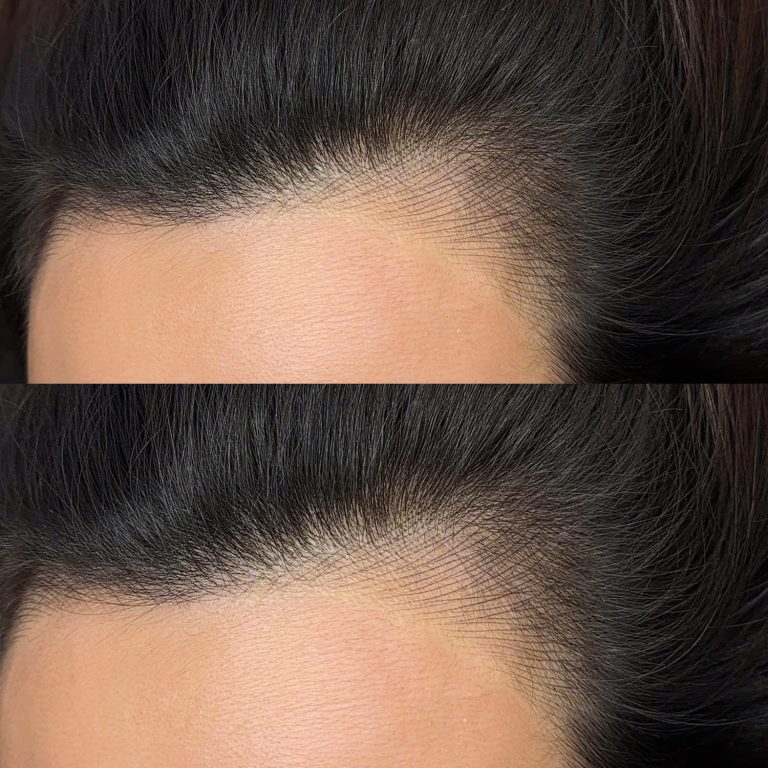
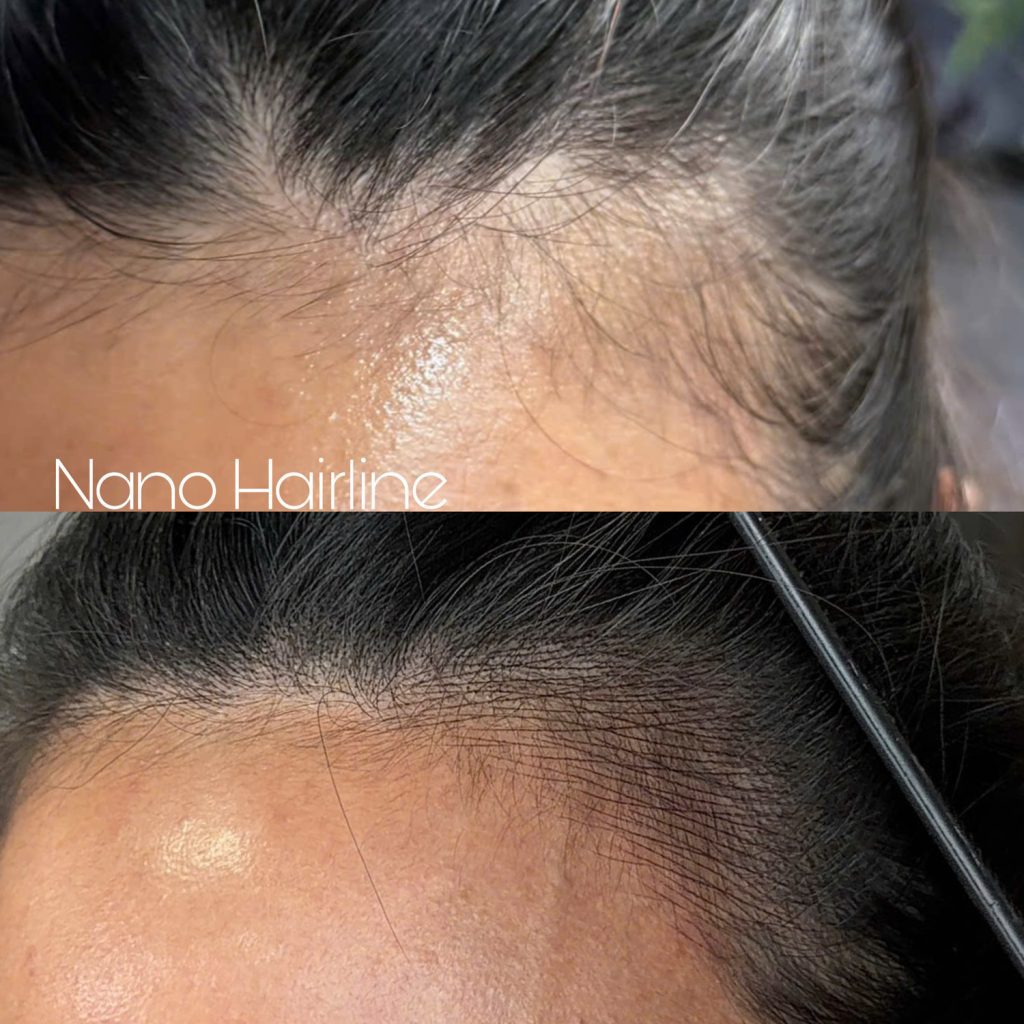
Nano hairline is the middle option that most people don’t know exists. It’s a cosmetic tattoo that uses a single ultra-fine nano needle to recreate the look of natural baby hairs along the hairline and temples, softening a receding or uneven line and giving it back a fuller shape. No surgery, no recovery, no daily concealer.
It won’t grow hair. Nothing about it is a medical treatment, and we’d never pitch it as one. What it does is restore the appearance of the hairline you had, which for a lot of women turns out to be the part they actually cared about.
How it actually works
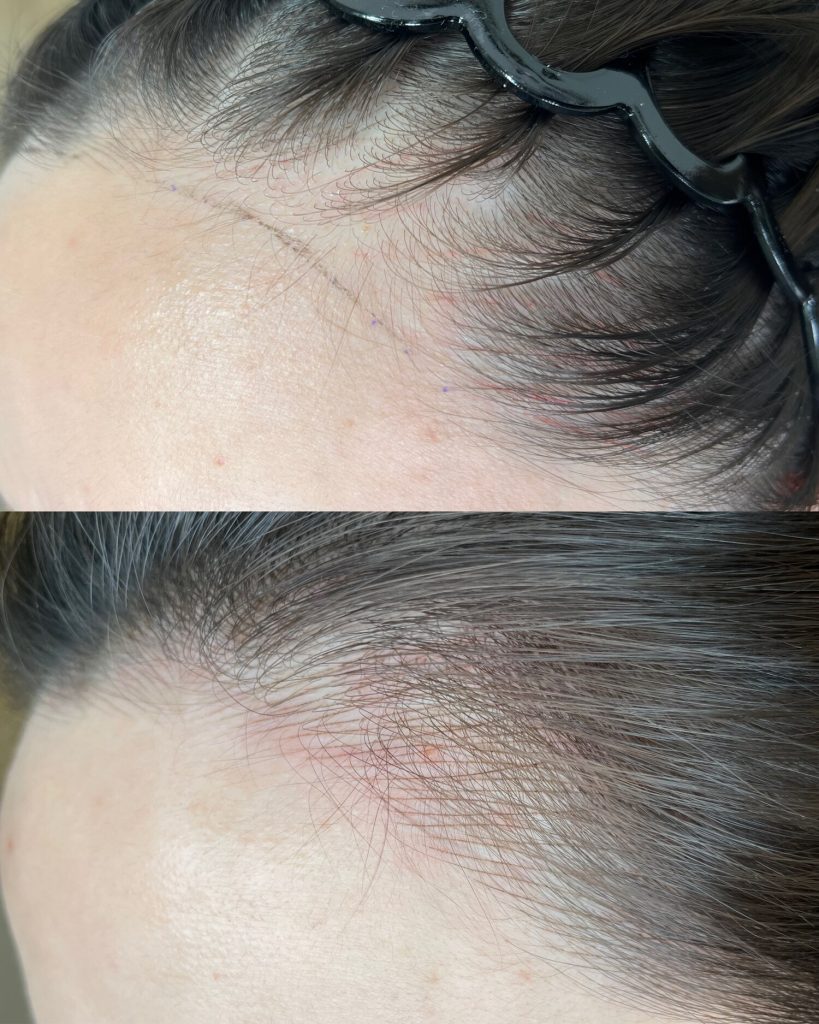
The technique uses a rotary machine rather than a hand-held blade, which is the key difference between this and microblading. That allows finer, more precise strokes with far less trauma to the skin, and it means the pigment can be placed with enough control to hold up at the front of the head where everyone can see it up close.
Individual strokes are placed to mimic the direction your own hair grows in, with soft shading worked in behind them where more density or blending is needed. Pigment is colour matched to both your skin tone and your natural hair colour, which is what stops it reading as something drawn on.
It’s the same nano machine technique we use for nano brows, applied to a different part of the face, with the same obsession about keeping the result believable.
Does it hurt?
Most clients describe it as mostly painless, more of a light scratching sensation than actual pain, and noticeably gentler than microblading or a standard tattoo machine. There’s no bleeding involved, which is part of why the healing is so straightforward.
How long does healing take?
Five to seven days, with minimal to no flaking and no downtime. You’ll want to avoid washing your hair directly over the treated area for the first three days, although face washing and showering as normal is completely fine. Swimming, saunas, steam rooms and heavy sweating are out until day five to seven. After that you’re back to normal styling, which is usually the whole reason people book in the first place.
How long does it last?
One to two years, with an annual touch-up recommended to keep the colour and density looking fresh. It’s one session plus a perfecting touch-up at four to six weeks, where the colour and density are built up properly.
Nano hairline versus a hair transplant
These get compared a lot, and they’re genuinely different things solving the same visible problem from opposite directions.
A transplant moves your own follicles and grows real hair, which is permanent and the right answer for some people. It’s also surgery, with the cost, the healing and the commitment that comes with that. Nano hairline doesn’t grow anything, it recreates the look of hair with pigment, and the trade-off is that it fades over one to two years and needs topping up.
The practical difference is scale. A transplant is a significant decision and a significant outlay. Nano hairline is an afternoon, a five to seven day heal, and a result you can change your mind about in a couple of years. For softening a receding front line or filling out thinning temples, it’s usually the proportionate option.
Who it’s not for
Nano hairline isn’t suitable if you’re pregnant or breastfeeding, or if you have an active skin condition on the scalp such as eczema or psoriasis. Certain other medical conditions may also rule it out, which is why we go through your full history properly at your consultation rather than taking a booking and sorting it out on the day.
It’s also not full-scalp density work. We cover the hairline, the temples, frontal restoration and small isolated bald spots at the front. If you’re looking for coverage across the crown, that’s a different treatment and a different kind of studio.
What it costs
Pricing depends on how much ground you’re covering, because treating one temple and treating the full frontal band are very different jobs.
Single Temple / One side only, light recession / $700
Both Temples / Both sides / $1,300
Hairline Only / Full frontal band / $900
Full Frontal Combo / Hairline plus both temples / $1,800
Frontal Bald Spot / Small isolated patch / $450
Touch-ups at four to six weeks are charged separately and start at $150. Your consultation is free, and your final price is confirmed there once we’ve looked at your hair loss pattern and the density you’re after.
Is it worth it?
That depends entirely on how much headspace the problem is taking up. If you’ve got a parting you never move and a powder you never leave the house without, you already know what it’s costing you in small daily decisions. If it genuinely doesn’t bother you, there’s no reason to do a thing about it.
What we’d say is that most of our hairline clients spent years assuming their only options were surgery or concealer, and were surprised to find there was something sitting in between.
If you want to know whether it would work for your hairline, book a free consultation. We’ll look at your hair loss pattern, talk through what’s realistic, and you’ll leave knowing your options whether you book the treatment or not.
Frequently asked questions
Is a thinning hairline normal in women?
It’s far more common than the conversation around it suggests. The hairline and temples are often the first places thinning shows up in women, and most people work around it quietly for years before asking anyone about it. Common doesn’t mean you have to live with it, but it does mean you’re not an unusual case.
Why is my hairline thinning?
Usually a combination of things. Years of tension from tight ponytails, buns, braids and extensions wear on the finest hairs at the front. Hormonal shifts are a big one, which is why it often shows up postpartum, in your forties, or after a period of significant stress or illness. Genetics and age both play a part too.
Can tight hairstyles really cause a receding hairline?
Repeated tension on the hairline is a well-recognised cause of thinning at the front and temples, and it’s one of the more avoidable ones. Easing off tight styles won’t reverse what’s already gone, but it can stop it progressing further.
Should I see a doctor before booking a cosmetic treatment?
If your hair loss came on suddenly, is patchy, or is happening across your whole scalp rather than just the front, yes, see your GP or a dermatologist first. There are medical causes worth ruling out, and a cosmetic treatment shouldn’t be your first stop in that situation. If it’s gradual thinning at the hairline and temples that’s been creeping along for years, that’s a different picture.
Do topical treatments like minoxidil work?
They help some women and not others, and it depends heavily on what’s causing the loss in the first place. That’s a conversation for your doctor rather than the internet, and it’s worth having before you decide between treatment routes.
What if my hairline keeps receding after I’ve had it done?
Worth raising at your consultation, because it changes how we design the shape. We’d rather map a hairline that still looks right in two years than chase a line that’s moving. If your hair loss is active or progressing quickly, that’s also a sign to involve a GP or dermatologist alongside anything cosmetic.
Is nano hairline better than microblading for the hairline?
For the hairline, yes. Microblading uses a hand-held blade to cut strokes into the skin, where nano uses a single ultra-fine needle through a rotary machine. That means finer strokes and significantly less trauma, which matters more at the hairline than almost anywhere else because it’s the part of the face people see up close.
How do I know if I’m a good candidate?
The honest answer is that you find out at the consultation, which is free for exactly that reason. We look at your hair loss pattern, your scalp, your medical history and the density you’re after, and tell you whether it’ll work. Some people walk out with a booking and some walk out knowing it isn’t the right fit, and both are a good outcome.
Still weighing it up? Have a look at the full nano hairline treatment page, or come in for a consult and ask Mia directly.


